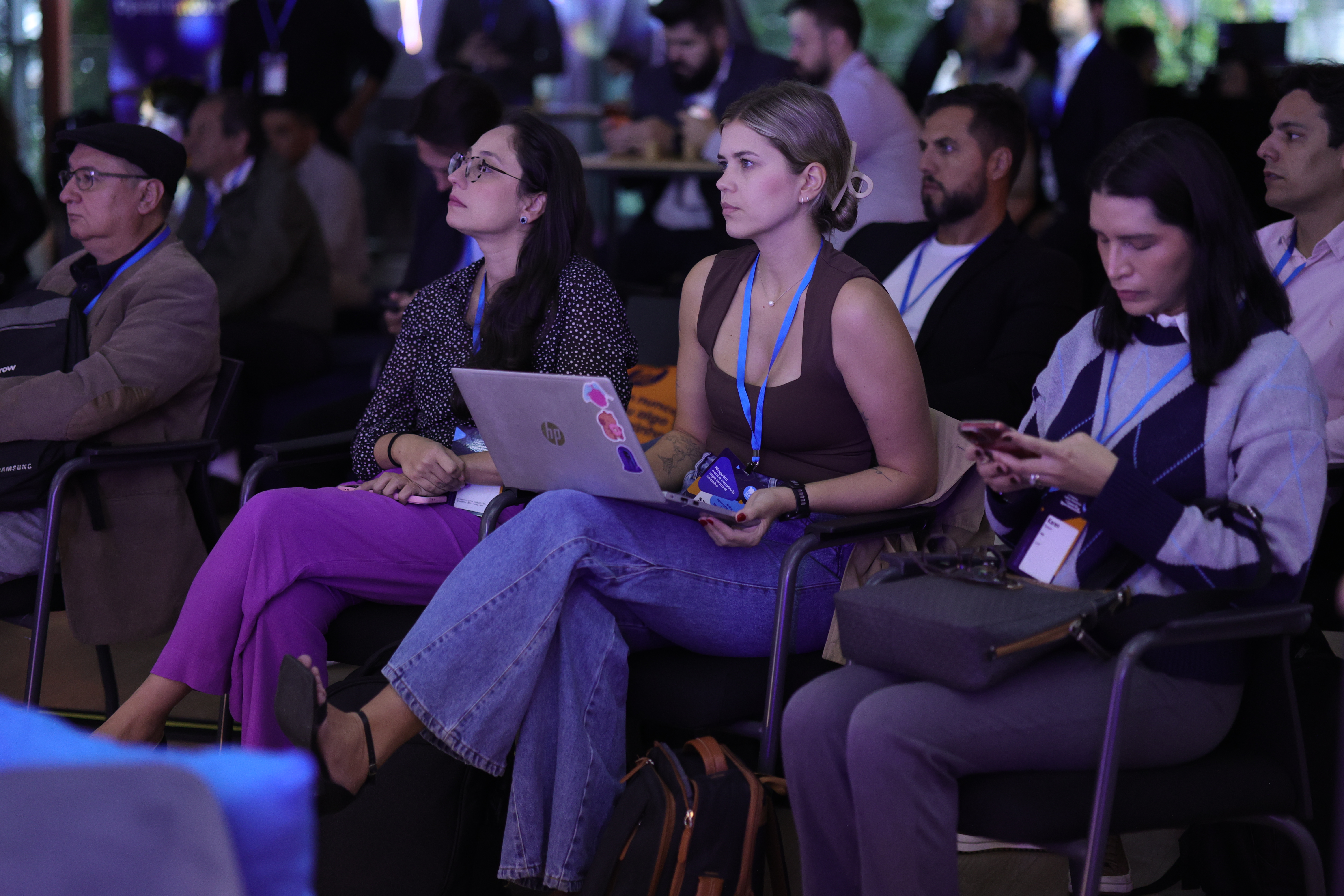
The sun shone at Natura's headquarters in Cajamar on the last day of November 29th, to welcome the guests of the 6th International Phytocosmetics Congress. Participants spent the morning and afternoon at the company for the closing of the Brazilian edition of the event, which featured lectures and a tour of Natura's factory.
During the series of presentations held in the company's training center auditorium, Dr. Kattesh V. Katti, an authority in the field of nanotechnology, spoke about how this science can relate to the plant kingdom. Kattesh is an advocate for the elimination of toxic chemical elements in the production of nanoparticles. Thus, he seeks phytochemical sources from plants and herbs necessary for the development of these structures, in a completely sustainable process that can have medical, agricultural, and other applications.
Natura's expertise in perfumery was represented in a lecture by Danielle Barbizan, fragrance development manager and olfactory evaluator for the company. She guided the audience through a journey of fragrances and history, reflecting the historical connection between cosmetics and natural ingredients.
Finally, Cristiane de Moraes from UEBT (Union for Ethical Biotrade) spoke about the maturation of society in perceiving companies' positions on sustainability, and how this is linked to the need to establish even more coherent biotrade practices to meet society's demands for effective actions, not just discursive ones.
Iguatemi Costa, scientific manager at Natura and one of the congress organizers, spoke to the Natura Campus website shortly after the event ended, reflecting on the activities and also recalling the importance of discussing this topic today, not only among academia and industry actors but also throughout society. Check it out:
What was seen at the closing of the 6th International Phytocosmetics Congress?
We had the opportunity to learn about high technology, with a presentation on nanotechnology and its connection to phytocosmetics; we took a brief journey through the history of natural products in perfumery and how this has evolved throughout human history, as well as how we at Natura contribute to the development of essential oils and the introduction of new natural products in perfumery; and we closed the way we opened, talking about ethics, which in a way was the backbone of the congress as a whole.
We were also able to showcase the work of UEBT (Union for Ethical Biotrade), which precisely discusses how to establish ethical relationships based on strong trust and respect in the treatment of natural product value chains. It was a good closure for a congress that was quite intense in knowledge.
What is the importance of Natura's support in the discussion about phytocosmetics?
The relevance is extremely high. In Natura's history, we found biodiversity around the year 2000 as a source of innovation, and this almost transformed the company's way of acting, in the sense of an even greater connection with natural products.
We have a successful story of phytocosmetics to tell, both from a technical-scientific perspective, from field and collection, to the development of ingredients and their transformation into well-accepted products that contribute to the company's growth.
We have an important case and a lot of knowledge to share. Making this connection with academia and other companies only adds to Natura's already successful journey of developing natural ingredients as a basis for innovation for its products.
In your view, how did the audience absorb the knowledge offered at the congress?
Throughout the three days, the feedback we received was very positive, from qualified people on the subject. There was an interested, engaged, and participative audience. I could sense a good energy among all the participants. I think we closed the congress on a high note.
Why is it important for society to discuss phytocosmetics today?
Any movement in society depends on several pillars, and science is very important. Being able to talk about phytocosmetic science, as a global player with relevant social influence, combined with the trend we see of a closer approach to the market of natural ingredients, represents something significant.
So, Natura, with its history and practices, with the science that is applied here, capable of transforming all of this into better products, is a considerable force in the sense that we believe is positive for society.