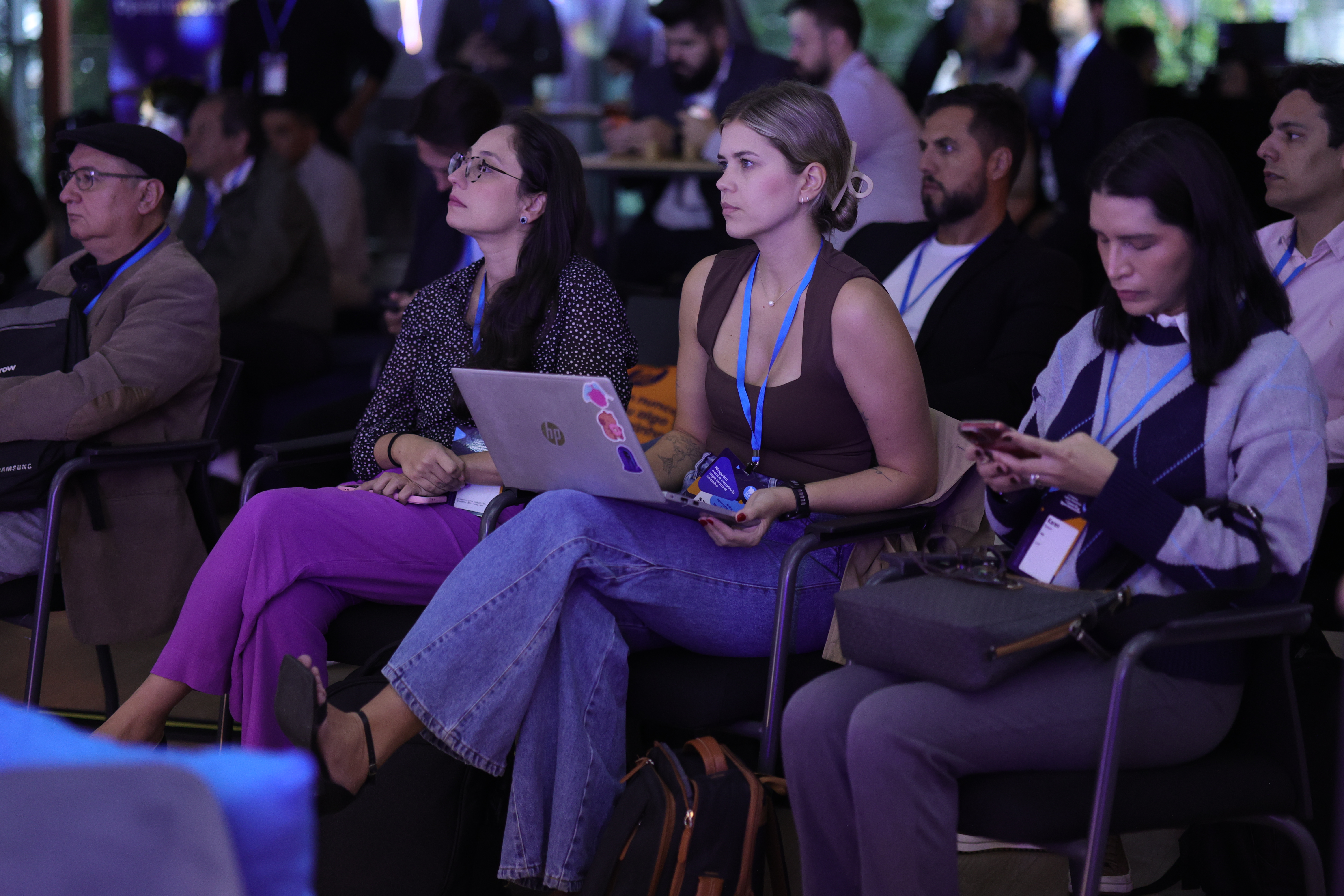
Creativity, cooperation, knowledge exchange, and detachment: these were, in the opinion of the participants, the words that marked the first edition of the prototyping marathon promoted by Natura Campus. They gathered for three days with researchers from Natura and the MIT Media Lab to seek solutions that would enhance the consumer experience and promote the integration of products in the virtual environment. The first edition of the Hackathon Natura Campus MIT Media Lab took place from August 4 to 6, 2014, at the company's headquarters in Cajamar (SP).
The co-creation mindset of Natura caught the attention of designer Ana Paula Lage from Minas Gerais. “I really enjoyed the challenge. I was already interested in the topic and had done a project in my master's that fit the theme, so I adapted that work to submit to the Hackathon call for proposals. Besides this coincidence, I already had a lot of admiration for Natura, as it is a reference company in innovation and co-creation. Submitting to the call was a way for me to get closer to the reality and truly experience this innovative and collaborative ideal,” she explains.
For her, the immersion stage was sensational. “Because of the group feeling, the diversity of areas of the people involved, and the variety of knowledge. Even though there were groups, there was no sense of competition, but of cooperation. I have no memory of competition during the event. Additionally, the opportunity to be close to people from a university that is a reference in innovation like MIT (Massachusetts Institute of Technology) was incredible,” she recalls.
Paul Cassin from Americana (SP), a Systems Analysis student with an emphasis on Digital Games, was also captivated by the challenge's atmosphere. “The teamwork was sensational with the integration of Natura staff and a researcher from MIT in each group, which added a lot,” he stated. The Hackathon entered Paulo's life about a year after his return to Brazil, following a period working in Silicon Valley. “I was very rooted in this technology and innovation thing, which made me very excited to participate in this type of event,” he remembers. Learning about the business model and other points related to Natura was also very important in the student's assessment. “The Hackathon was, in addition to an exchange of experiences, a point of contact with a different world, a different area that added a lot of knowledge for all of us,” he evaluates.
Abandoning initial ideas was not an easy task for the participants, but it was one of the great learnings of the challenge. “The proposal of detachment came from the mentors. It was a real deconstruction. The initial project was like a ‘crutch’ that would stay with us until the end. They took that away, destabilized us, and built another foundation for us to mature our ideas. From there, we started combining each person's knowledge in the group with the information that Natura's specialists provided us about the brands and objectives,” Ana Paula shares.
According to the designer, the availability of materials to develop the prototype was very important. “And there was a person from MIT who knew a lot about electronics, so everything we thought of doing, she found a way to make it a reality,” she says. Paulo adds: “The cool thing is that ideas emerged from connections between different people, with different experiences. There were people from Salvador, from Roraima, from all over. This enriched the ideas.”
At the time he participated in the challenge, Paulo had just started his own business and was able to bring a lot of what he experienced at the Hackathon to his company. “I took several ideas that I could apply there. After six months, the opportunity arose to come to Natura, to work on some projects here. For me, it was a huge achievement. I had already been keeping an eye on those projects created at the Hackathon, and now I have the opportunity to be close to them. That alone was a great prize for me,” he celebrates.
Ana Paula also saw significant advancements in her own profession. “Participating and seeing a fast and efficient way to design like this was my greatest gain as a designer. I was fortunate that Natura wanted to continue the project that my team had proposed. That was very gratifying. Having such a strong company in your portfolio is very good,” she concludes.
And if they had to give tips to the participants of the next Hackathon? What would Paulo and Ana Paula say?
“I would say to come with an open heart and mind to learn a lot and absorb as much as you can from all the people who will be there. Because that is the most precious part of this experience. To gather and connect everyone's knowledge to build something new. So even if you have your idea, be open because many minds thinking towards the same goal can come up with more than one, and then the result is fantastic,” Ana Paula asserts.
Paulo emphasizes that the Hackathon is not just for those in the tech field. It is for everyone, with or without experience in these types of challenges. “I would say for people to really participate, not just to give ideas, but to live the experience. That is my invitation: come see the experience. Being in this environment that fosters ideas, fosters connection between people and the environment. One tip is to go without attachment to the idea and to what you have already experienced. Experiences add up, but you have to be open to learn, as both a teacher and a student. There is always more to learn from others. It is very hard to leave the same way you came in. You certainly take a lot with you, even if it’s not the prize,” he defends.