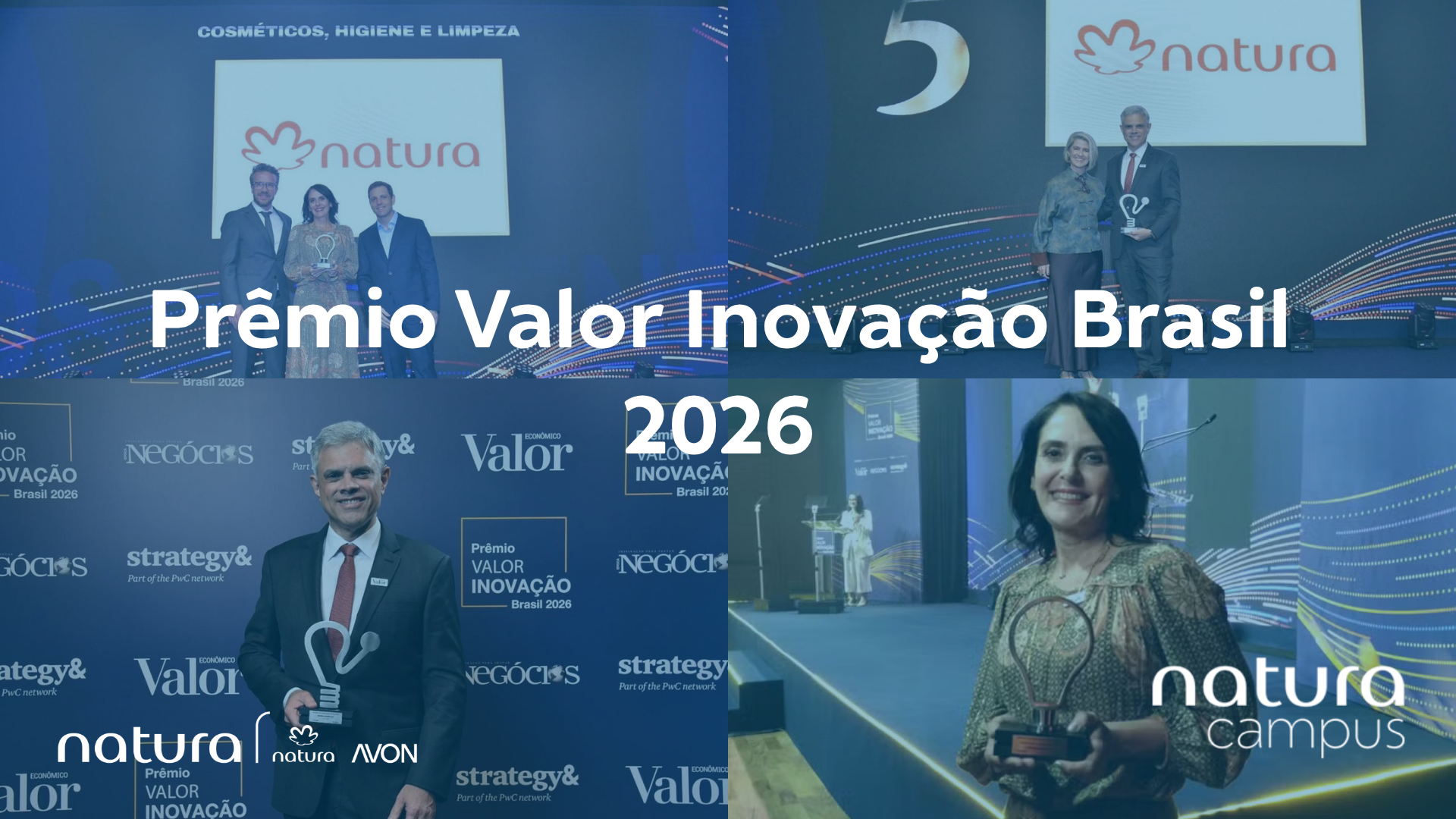
By acquiring an increasingly important role in the company's business, collaborative open innovation and network formation at Natura have just gained even more support and relevance with the relaunch of the Natura Campus Program, which took place in November 2011. Various activities were carried out, such as presentations by the Natura Partnerships Team at universities in Rio Grande do Sul, Santa Catarina, São Paulo, and Minas Gerais, at the São Paulo Research Support Foundation (FAPESP), gathering representatives from public universities in São Paulo, in addition to a web conference on the 30th. As a result, more than 600 people learned about the new features of the Program. In the first half of 2012, more institutions from different regions of Brazil will also be visited to expand its outreach.
The goal of Natura Campus is to establish a constant relationship with the scientific community, favoring the use of knowledge and networks to generate opportunities for interaction, collaboration in research, and value generation for Natura and its network of partners.
In this context, Natura Campus is presented in 2011 focused on relationships with the scientific community, allowing for learning from the interaction between Science Institutions and Natura and the opportunities for advancement in this area with mutual and synergistic gains for all parties. It becomes open to all sciences, including humanities and applied social sciences, in addition to Natura's traditional research lines focused on sustainable technologies, ingredient sciences, Well-Being, Skin and Hair, and Senses and Experience Design.
“With Natura Campus, we intensify the strength of the relationship between Natura, universities, science institutions, and research support and funding bodies. The open innovation model adopted by us enables these partnerships and contributes to increasing the company's competitiveness in the market and to the technological and economic development of the country,” explains Luciana Hashiba, manager of innovation network management at Natura.
Given the internationalization of the company and the search for increasingly relevant opportunities for interaction in science and technology, the Program plays a crucial role in also creating opportunities to connect research conducted in Brazil and abroad. Thus, the expansion of the scope to a global reach is another change that occurs in its new phase.
Until 2011, Natura collaborated with 18 partner Science and Technology Institutions from nine different Brazilian states and reached the milestone of 32 completed collaborative projects and 7 ongoing projects focused on basic or technological scientific research.
Action fronts for the Reinvention of the Program
To operate as a Relationship Program with partners from Science and Technology Institutions, various forms of interaction have been developed that establish connections based on science, technology, market, and collaboration opportunities with the public. Among them, the Digital Interactivity stands out, meaning the total integration of Natura Campus into the web with modern tools for knowledge construction and collaboration, Media Center, a space on the Natura Campus Portal that organizes and provides information about innovation at Natura, allowing interested parties access to company data, case studies, and others, and the Challenges to the network, which will be launched with the specific goal of presenting a demand to Institutions that may be of a technical, scientific, creative, infrastructural, strategic nature, among others, addressing specific innovation themes.
Another highlight is the Research Collaboration Proposals with Natura, in which Natura makes the submission of collaboration proposals available. To effectively organize and generate comparative technical-scientific merit analyses, the Program now adopts determined submission flows, a model that allows for the planning of research activities internally and within the partner network.